


[adrotate group=”1″]
Over 600 people attended this year's The Future of TV Advertising Canada in downtown, Toronto to learn about the latest trends and innovations in television advertising in Canada. Profectio was on hand to capture the day with support from our friends at Datonics.
Behind every great campaign is a high-quality team, and behind every great team is a successful marketer. Join us for our newest series, Getting To Know... where we talk with top marketers from across Canada.
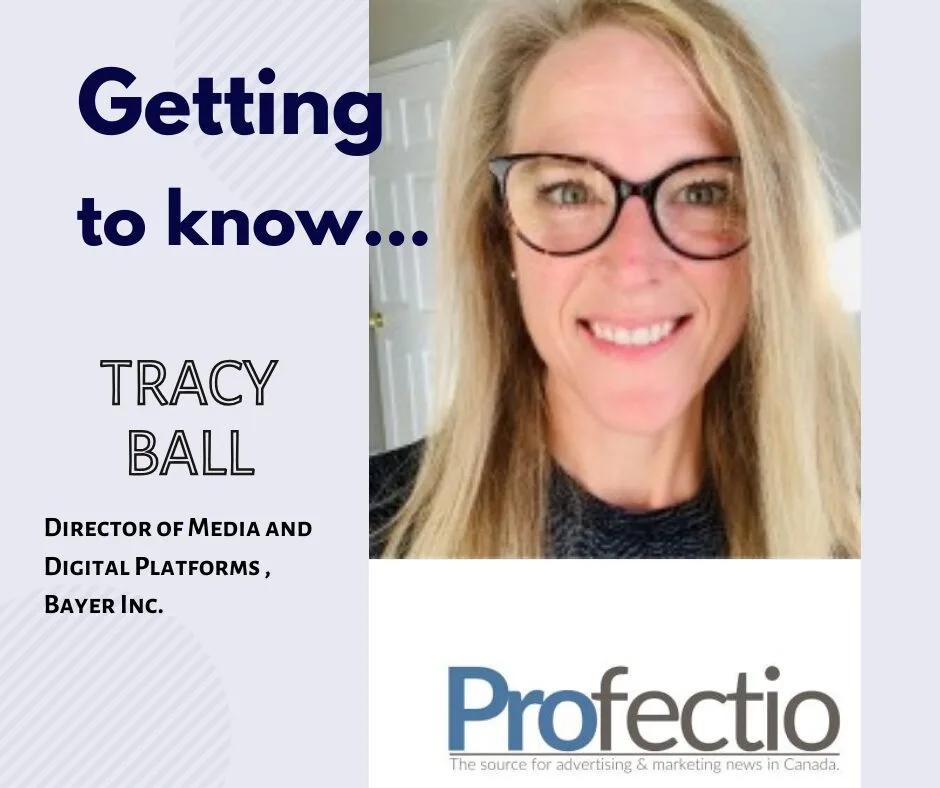
We took a few minutes during the conference to sit down with Tracy Ball, Director of Media and Digital Platforms, Bayer Inc.
Who are you and what problem do you solve?
Tracy: I am Tracy Ball. Currently the Director of Media and Digital Platforms over at Bayer Consumer Health and Pharmaceuticals. I'm a mom of four. I have a twenty, almost twenty-six-year-old. I know, it's crazy. Twenty-two, eighteen, and fifteen-year old.
The problem I like to solve is connection. How do we connect people to brands, to experiences? That's sort of my that's my mission.
How did you get into the industry?
Tracy: My cousin worked for Hype at the time, that's an old agency, I don't even know if it exists today. It was an entertainment agency. And he was like - “I think you are better suited for media. It's less late nights, not by much." But yeah, so that's how I got in. Just a friend of a friend, a cousin got me into the industry.
What keeps you in the industry? What's the excitement for you?
Tracy: It changes so fast. And so much. Just when you think you've got things figured out, there's a new problem to solve for. And so I am a lover of a good challenge.
How do you keep your staff motivated?
Tracy: Asking them what they love to do and doubling down on it.
Honestly, I have a small but mighty team at Bayer. We're in-house. So all of our digital is in-house and they're lean and mean. We choose to do things that we know will move the business forward and we let the team decide who gets to do what on an individual project basis so that they stay passionate about what they're doing.
How do you define leader today?
Tracy: That's a great question. I think leadership actually comes back to servancy.
As a leader, it's my job. to ensure that the people on my team, the people on peripheral teams feel appreciated, engaged and doing things that that build them up. So that's leadership to me. It's not about how I take the team to a different place.
It's about supporting each of their goals and helping them move forward.
Do you have any advice for the next generation?
Tracy: Lean in. Honestly, there's the me time. I understand that nobody wants to work 12 hours a day. Nobody wants to work 10 hours a day.
I actually think it's the people who stay curious. who lean in, who ask questions, they ask, why are we doing it this way? Could we do it this way instead? Those are the folks who are going to make it in the next wave of our industry because it's changing so fast. We have to keep questioning things and not just lather, rinse and repeat.
What Bayer is?
Tracy: Bayer is actually a brand of brands. Not many people correlate Claritin with Bayer or they might not know that RestoraFIBRE is a Bayer product. So you know one of the things that we're now trying to do is make those connections between the brand families so that people understand that the Bayer cross is on all of these brands.
What are some of the challenges of managing a portfolio with so many brands?
Tracy: It's the lack of Bayer identity. That is the challenge. One of the things we're trying to bring back in, some of our competitors have done it. You've seen Kenvue start to add that Kenvue logo on all of their varied products.
Bayer aspirin is 150 years old so it's not a new product, but it has a new audience if we're not constantly looking at improving the connection between our brands, then they sit in silos and that's not beneficial for any business.
Dave: Is there any specific thing that you'd like to achieve or would make, you know, success when we fast forward to December of 2024?

Learn more about how Datonics.
Is there any specific thing that you'd like to achieve or would make, you know, success when we fast forward to December of 2024?
Tracy: I love what Numeris and Nlogic are doing with the Trade Desk, full stop. I am going to be speaking about that this afternoon. But it's helping us get to a place where we can understand what's happening across our business, as opposed to a digital versus television siloed experience.
And that's what I want to happen before the end of the year so that 25 just becomes that much more efficient.
While on stage seemed to react when they talked about frequency caps. What does that mean to you?
Tracy: As a consumer? It's my biggest pet peeve with any video product is the likelihood of me seeing the same ad at least two or three times in a 20-minute period.
That's inefficient. That's wasteful. It's a negative consumer experience. And so yes, for the love of Pete at a frequency cap and I think that's not just important from a brand's perspective It's also important from a publisher perspective to ensure that the consumer experience is always first.
How is AI impacting creative?
Tracy: Honestly, I think it's probably tech because in each platform that we're buying video in whether it's Amazon, Google, Trade Desk, whatever, in every single one we are putting frequency caps. We're doing what we think is the right thing. But as you know, it's not a single source that's being shown to the publisher to accept that impression buy.
And so if I'm buying in three different platforms, I frequency capped in all of those platforms, but they're not talking to each other. And so the monetization on the publisher side says I want this one, this one, and this one. But the publisher might not know all three are from the same brand or even the same ad.
So the technology is getting in the way of the frequency cap. This is why we as buyers need to ensure we put them on. This is why publishers need to ensure that they're imposing frequency caps as best they can. And the tech has to catch up.
How is AI impacting creative?
Tracy: It's huge. It's a discussion I that we've been having for a while now. AI isn't new, but it's adaptation and acceptability is new. And so we want to do what's right for our brands, which means authenticity. So sure, AI comes into play. Maybe it helps us with keywords in search.
Maybe it helps us with understanding the right context of a specific high-value audiences. But I don't know how far it's gonna be embedded into creativity if we want an authentic experience.
