


[adrotate group=”1″]
Catherine J.H. Cho has played a key role at Index Exchange in her position as Lead Product Manager, and previously as Senior Product Manager. One of their strengths is their vision, which allows them to drive the technology and product roadmap.
Profectio recently sat down with Catherine to discuss the changing live event advertising, she has noticed that more viewers are choosing streaming platforms over traditional linear TV to consume live sports, daily news, and other events, which is forcing the advertising industry is pivoting to keep up.

Learn. Connect. Grow.
Join a thriving community of media buyers and planners where you can sharpen your skills, access exclusive content, and connect with industry experts—all for free!
How do you see the role of programmatic advertising evolving in the live event and streaming space over the next few years?
Catherine - Over the last several years, we’ve seen a surge in live events, like sports, political debates, and award shows, being delivered through streaming apps in lockstep with shifts in how audiences consume TV content. Ad-supported streaming has grown rapidly, but much of live event buying still relies on bespoke, one-off executions with handpicked partners—far from the scalable, automated promise of true programmatic. That’s changing. As an industry, we’re coming together to define a new era of live event buying and selling, anchored by the shared standardized practices. Server-Side Ad Insertion (SSAI) providers, Ad Servers, SSPs, and DSPs are recognizing that we need to “speak the same language,” learning how to handle the unpredictable and high-concurrency nature of live ad breaks. With initiatives like the IAB Tech Lab’s Live Event Ad Serving (LEAS) working group, we’re bringing new specifications to life and drawing out the best practices that work for everyone. In the next few years, we’ll see dramatic growth not only in available live inventory, but also in the volume that can be programmatically activated and optimized.
What are the biggest challenges advertisers face when trying to reach audiences in live streamed environments, and how can they overcome them?
Catherine - Advertisers face a distinct set of challenges in live-streamed environments, and they fall into four main categories:
- Unpredictability of Ad Breaks: Even in scheduled programming, the exact timing and duration of ad breaks is often unknown until the last moment. Unscripted pauses—like injury timeouts or sudden news developments—introduce volatility that traditional pacing algorithms were never built for. This makes campaign planning, audience targeting, and budget pacing more difficult to execute effectively.
- Massive, Concurrent Traffic Spikes: Live ad breaks don’t trickle in—they hit all at once. Millions of viewers can trigger bid requests simultaneously, creating traffic surges that strain the programmatic supply chain. Each layer—SSAI, ad servers, SSPs, and DSPs—has different thresholds for concurrent volume and response latency. Without thoughtful concurrency management, these spikes can result in suboptimal budget pacing, dropped supply, and incomplete pods—leaving numerous engaged viewers unreached.
- Lack of Standardization Across the Stack: From bid signalling to prefetching behaviour, the ecosystem lacks a unified set of practices for live ad delivery. There’s no consistent way to identify true live event contents in the bid stream and to coordinate strategies across the various servers and platforms that manage bid requests. As a result, buyer optimizations often don’t align with publisher workflows, and available impressions may go unfilled despite demand.
- Need for Creative Pre-Registration: In traditional programmatic, buyers often submit new creatives in real time, allowing hours for approval and processing. That doesn’t work for live events—by the time creative audits or transcoding are complete, the moment is gone. To ensure smooth delivery during live ad breaks, creatives must be registered in advance with the exchange, publisher ad server, and SSAI. This allows for pre-approval, transcoding, and caching—so everything is production-ready when the break hits. But today, there’s no scaled or standardized system for doing this. Without clear coordination across all parties, creative readiness becomes a blocker for real-time activation.
Overcoming These Challenges
The solution lies in cross-industry collaboration. Through initiatives like the IAB Tech Lab’s LEAS program, we’re building a shared framework to address these very issues—standardizing APIs to know the size of audience currently tuned in, best practices for prefetching to smooth the concurrent peaks, establishing signalling protocols for live events, and formalizing creative preregistration, and more. The goal is simple but ambitious: to make every impression opportunity in live environments addressable and biddable—with no missed moments.
With the increasing fragmentation of media consumption, what strategies should brands adopt to ensure consistent engagement across different platforms?
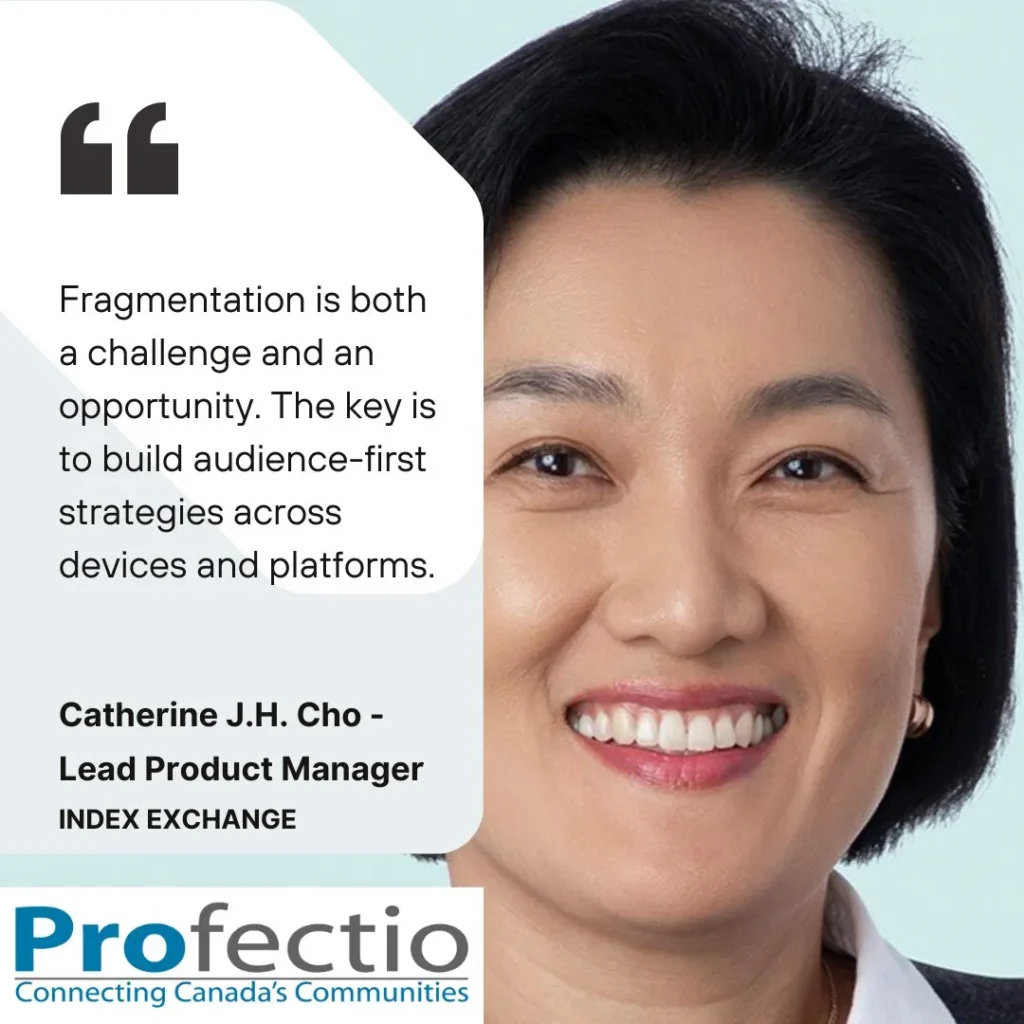
Catherine - Fragmentation is both a challenge and an opportunity. The key is to build audience-first strategies across devices and platforms, rather than anchoring around specific supply channels.That could mean centralizing media planning and creative workflows to adapt messaging for each screen. Someone watching a show on their mobile device might be in discovery mode, whereas the same person watching it on a smart TV later that night is likely in a lean-back mindset. Matching creative tone and format to context is crucial. Consistent measurement is just as important. Advertisers should seek out holistic solutions capable of measuring reach across the various platforms a user engages with and attributing that reach to outcomes wherever possible. Whether through user or household identifiers, aggregated audience cohorts, or on-device ad decisioning, the goal should be to create a cohesive view of reach and frequency across the fragmented ecosystem, tied to the outcome goals that matter to marketers.
How can advertisers balance the need for precise targeting with the growing concerns around consumer privacy and data regulation?
Catherine - The industry is in the midst of a fundamental shift toward privacy-centric addressability. With third party cookies going away, IP signals being limited, and ever-evolving privacy regulationsInstead, we’re seeing a mix of authenticated and non-authenticated solutions emerge. On one side, we have login-based identifiers like Unified ID 2.0 or RampID, which offer consented, cross device addressability. On the other hand, we have contextual signals, publisher first-party data, and seller-defined audiences that allow for privacy-safe audience addressability without explicit identifiers.Clean room technologies are also gaining momentum—they allow buyers and sellers to match data sets and derive insights while maintaining strict privacy boundaries. Ultimately, advertisers must stay agile. There’s no one-size-fits-all solution for the post-cookie world, but by diversifying their identity strategies and working closely with publishers and platforms, brands can achieve precision without sacrificing trust.
What innovations in measurement and attribution are helping brands better understand the effectiveness of their ad spend in streaming and live events?
Catherine - As streaming TV matures into a performance-driven channel, brands are demanding clearer, more actionable insights into the ROI of their streaming investments. This shift is fueling a wave of innovation in measurement and attribution—particularly in high-stakes, high-concurrency environments like live events. Deterministic attribution models are gaining traction, with advertisers increasingly linking exposures to business outcomes via hashed emails, unified IDs, and device graphs. These connections enable real-world measurement across channels—from site visits and app installs to in-store purchases—helping brands move beyond proxy metrics and toward outcome-based evaluation. Meanwhile, we’re seeing a growing emphasis on cross-platform measurement solutions. Advertisers are turning to advanced streaming TV platforms and independent measurement providers that offer unified reporting across fragmented environments. It’s also worth noting the broader momentum around alternative currencies and standardized audience measurement. While Nielsen remains prominent, players like Comscore, VideoAmp, and iSpot are pushing for wider adoption, and many major publishers and streamers are embracing a multi-currency future to enable more flexible and granular measurement.In short, the industry is actively retooling its measurement infrastructure to meet the complexity of modern streaming. These innovations are essential to unlocking the full performance potential of streaming TV and live event advertising.
To learn more about Index Exchange click the link.
Powered by Media Marketplace
