


[adrotate group=”1″]
“By 2030, AI will no longer be a tool you use to support your business; it will be the engine that defines it.”
In the world of marketing and advertising, we’ve spent the last two years treating Artificial Intelligence like a high-end calculator—a way to trim the fat, automate the mundane, and squeeze a few more points of efficiency out of our budgets. But according to a massive new global study from the IBM Institute for Business Value, that "efficiency first" era is quickly coming to a close.
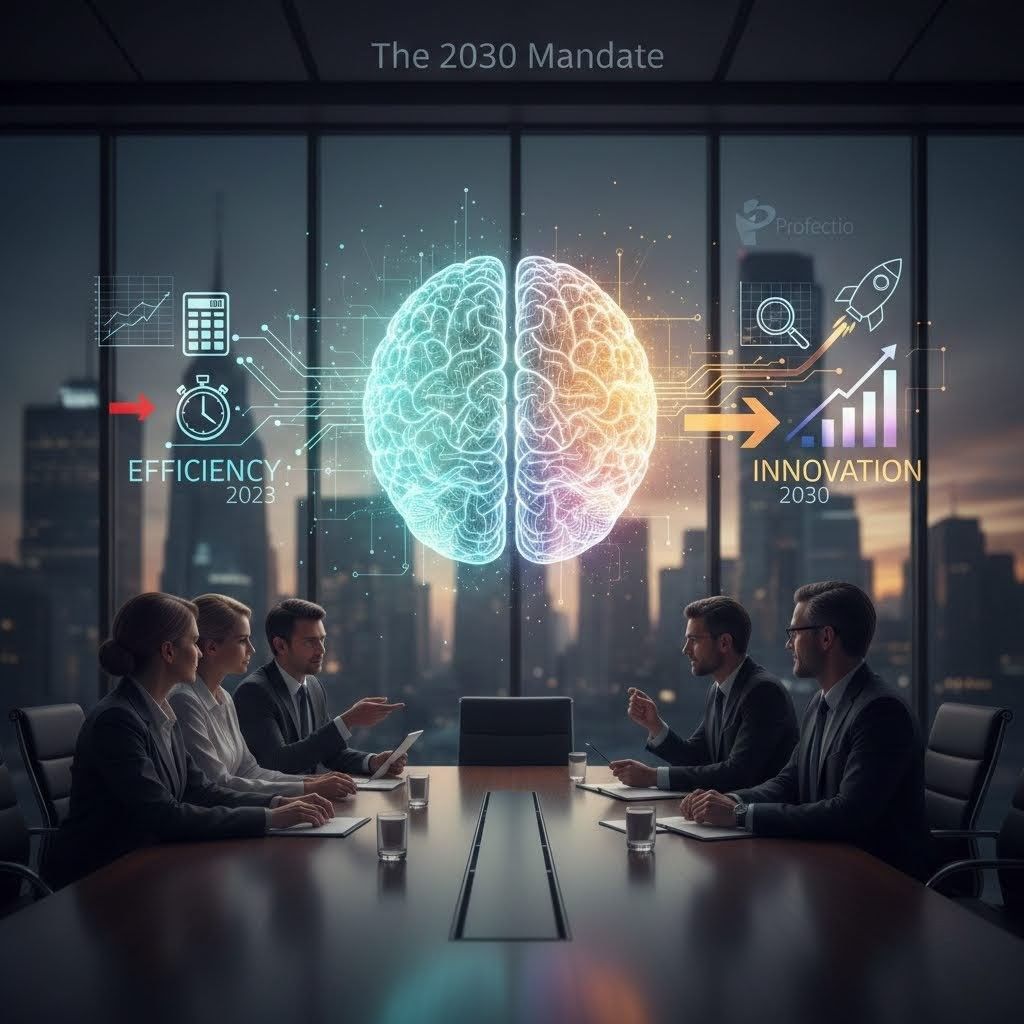
IBM surveyed over 2,000 C-suite executives, and the results paint a picture of a total industry pivot. If you’ve been looking at AI as a cost-cutting measure, it’s time to change your lens. By 2030, the winners won't be the ones who saved the most money; they’ll be the ones who used AI to reinvent how they grow.
The Innovation Pivot
Right now, nearly half (47%) of AI spending is focused on efficiency. However, by 2030, executives expect to flip the script, with 62% of AI investment dedicated to innovation.
The message is clear: You can’t cost-cut your way to the top. The real value lies in using AI-powered productivity gains—which IBM projects will hit 42% by the end of the decade—and reinvesting that "found time" and "found money" into bold, new growth initiatives.
The 79% Revenue Gap
One of the most startling statistics in the report is a massive disconnect in the C-suite. While 79% of executives expect AI to significantly contribute to their revenue by 2030 (up from just 40% today), only 24% have a clear roadmap of exactly where that revenue will come from.
For agencies and marketing departments, this is the "Golden Opportunity." There is a desperate need for leaders who can bridge the gap between AI's potential and its actual bottom-line impact.
Smaller Models, Bigger Results
Interestingly, the study suggests that "bigger isn't always better." While Large Language Models (LLMs) dominated the initial hype, 72% of executives expect Small Language Models (SLMs) to actually surpass LLMs in enterprise value.
The future is bespoke. Organizations that scale AI across multiple workflows using smaller, custom models are anticipating 55% higher operating margins. For Profectio readers, this means the competitive edge isn't just about using "the big tools"—it’s about the proprietary data and specialized models you build for your specific niche.
A New Kind of Leadership
The shift isn't just technical; it's cultural. IBM predicts that by 2030:
- 25% of enterprise boards will include an AI advisor or co-decision-maker.
- 74% of leadership roles will be redefined.
- Mindset will matter more than skills. As 57% of current skills are expected to become obsolete by 2030, the ability to adapt and experiment will be the most valuable currency in the room.
The goal for the next five years isn't just to work faster—it’s to work differently. Are you ready to stop using AI to do the same things better, and start using it to do things you never thought possible?
[adrotate banner=”6″]
